SRT troubleshooting: Stop guessing, use BBright RMD as a neutral point of truth
Blog & white papers
26 May 2026
SRT has become a standard choice for live contribution over unmanaged networks. It gives broadcasters, service providers, sports producers and content owners the flexibility to transport high-quality video without depending only on dedicated connectivity.
For live sports, remote production, event contribution and channel distribution, that flexibility is a major advantage.
But when something goes wrong, SRT troubleshooting can quickly become complex:
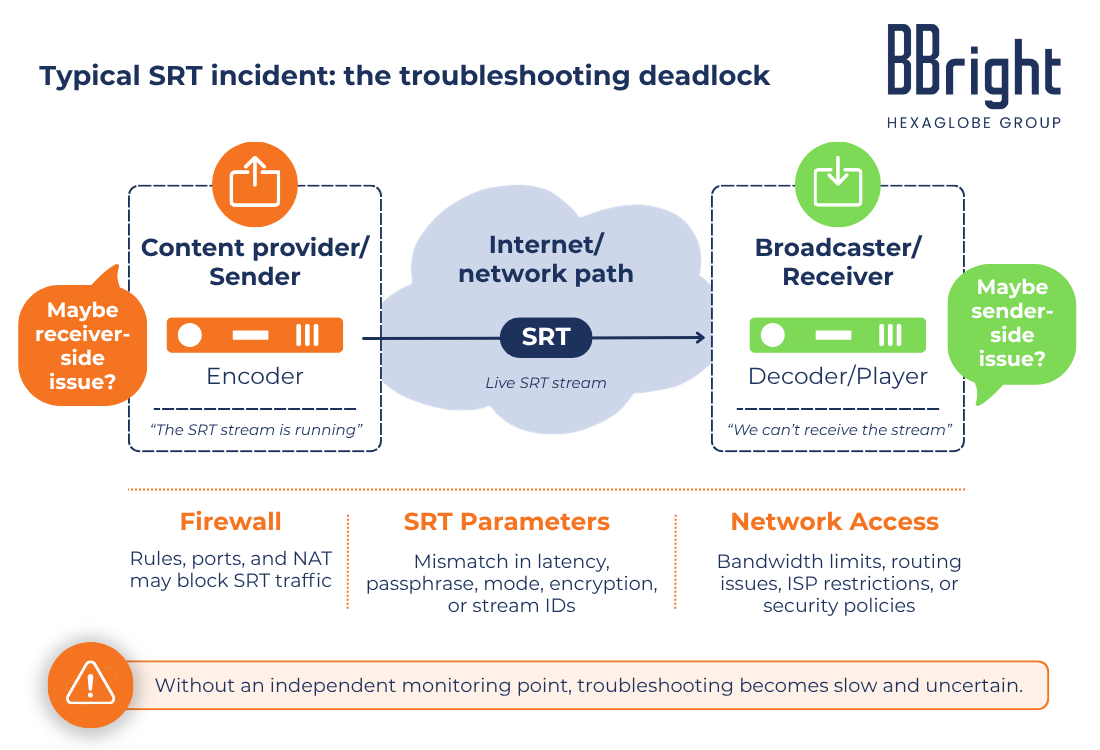
- The sender says the stream is running.
- The receiver says nothing is arriving.
- The firewall rules appear to be correct.
- The encoder looks healthy.
- The decoder still shows no signal.
- And the production team needs the feed on air now.
In that situation, the real challenge is not only to fix the issue. The first challenge is to establish a clear technical fact:
Is the SRT stream actually reachable from outside the sender’s infrastructure?
Without an independent answer to that question, troubleshooting often turns into a long exchange of assumptions between teams. Each side checks its own systems, but nobody has a neutral view of the transmission path.
This is where the BBright RMD becomes a powerful operational tool.
From debate to evidence
When a receiving partner cannot access an SRT feed, the first priority is to determine where the investigation should start:
- Is the sender really publishing the stream correctly?
- Is the SRT mode properly configured?
- Is the public IP address reachable?
- Is the port open?
- Is NAT forwarding working as expected?
- Is the receiver using the correct passphrase, latency, mode and port?
- Is the issue in the network path between both sites?
Without an external monitoring point, all these questions can take time to answer.
The BBright RMD changes the troubleshooting model by acting as a neutral point of truth.
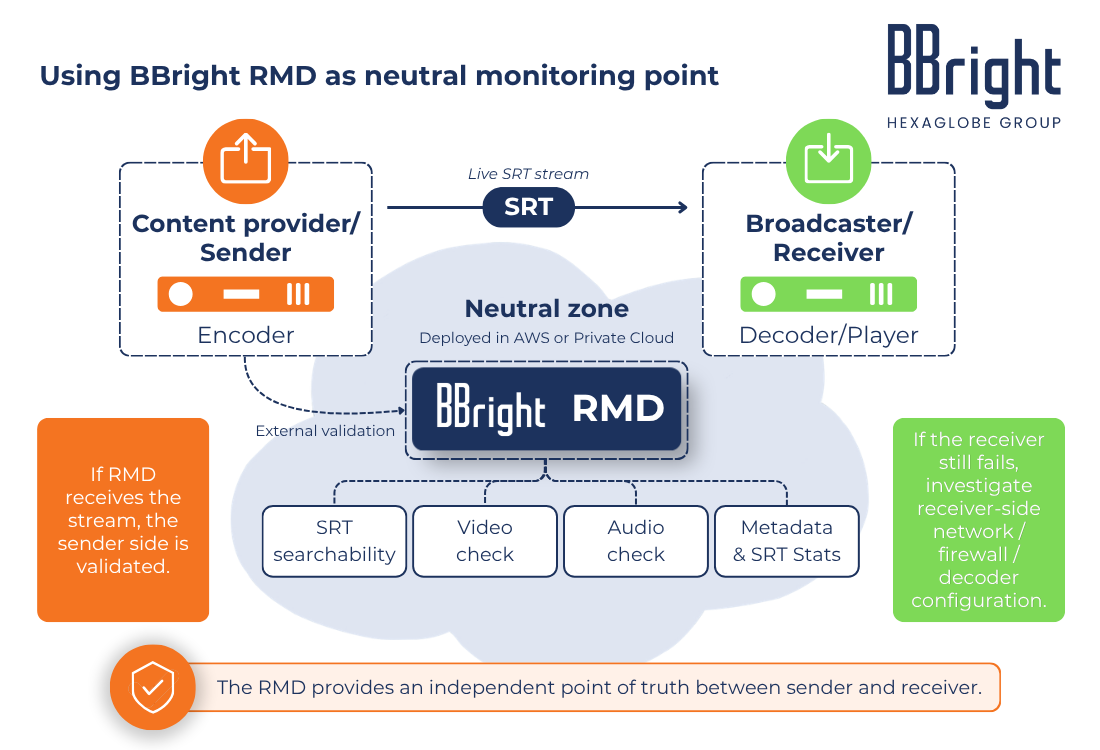
Instead of placing the monitoring tool inside the sender’s network or inside the receiver’s infrastructure, the RMD can be deployed in a third-party environment, such as AWS or a private cloud. From that independent location, it attempts to receive the same SRT stream as the final destination.
This simple architecture brings immediate clarity.
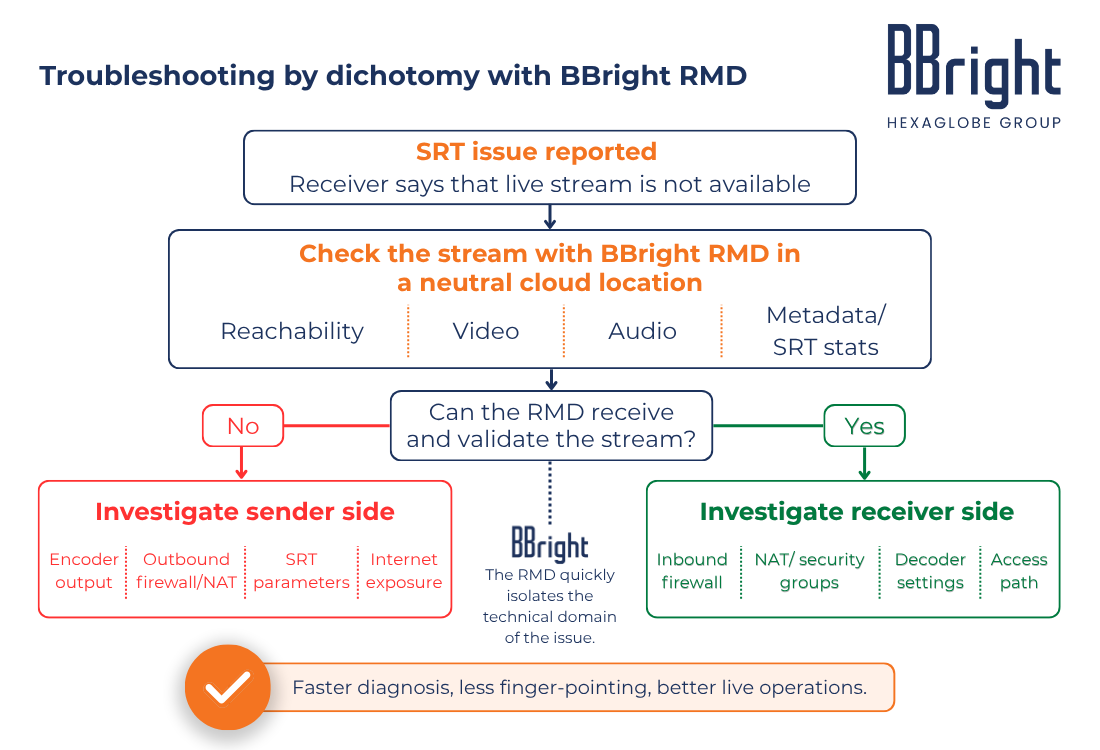
If the RMD receives the stream, the sender has proven that the SRT feed is externally reachable. If the final receiver still cannot access it, the investigation can move quickly toward the receiving infrastructure or the receiver-side network path.
If the RMD cannot receive the stream either, the issue is likely on the sender side, in its SRT configuration, firewall, NAT, public routing or outbound network path.
The discussion is no longer based on opinion.
It is based on evidence.
Splitting the problem in two
In live operations, time matters. The longer engineering teams spend debating where the issue comes from, the higher the operational risk.
The BBright RMD helps split the problem into two clear domains.
First, it validates whether the SRT stream is available from an external network. This helps confirm that the sender is publishing the feed correctly and that the stream can leave the sender’s environment.
This first check is essential. It can help validate:
- encoder output availability;
- SRT caller/listener configuration;
- IP address and port configuration;
- firewall and security group rules;
- NAT and port forwarding;
- public network reachability.
If the RMD cannot connect from a neutral location, the receiver is probably not the root cause. The stream is simply not available to the outside world in the expected way.
Once the RMD successfully receives the feed, the diagnosis changes. The sender side has been validated from an independent location. The next question becomes:
Is the content inside the stream correct?
Connectivity is not enough
A common mistake in live IP troubleshooting is to stop at connectivity.
Receiving packets does not necessarily mean that the service is valid.
An SRT stream may be reachable while still carrying the wrong signal, missing audio, incorrect service structure, unstable bitrate, missing metadata or transport stream errors.
For professional broadcast operations, “the stream connects” is not enough.
Operators need to know whether the feed is usable.
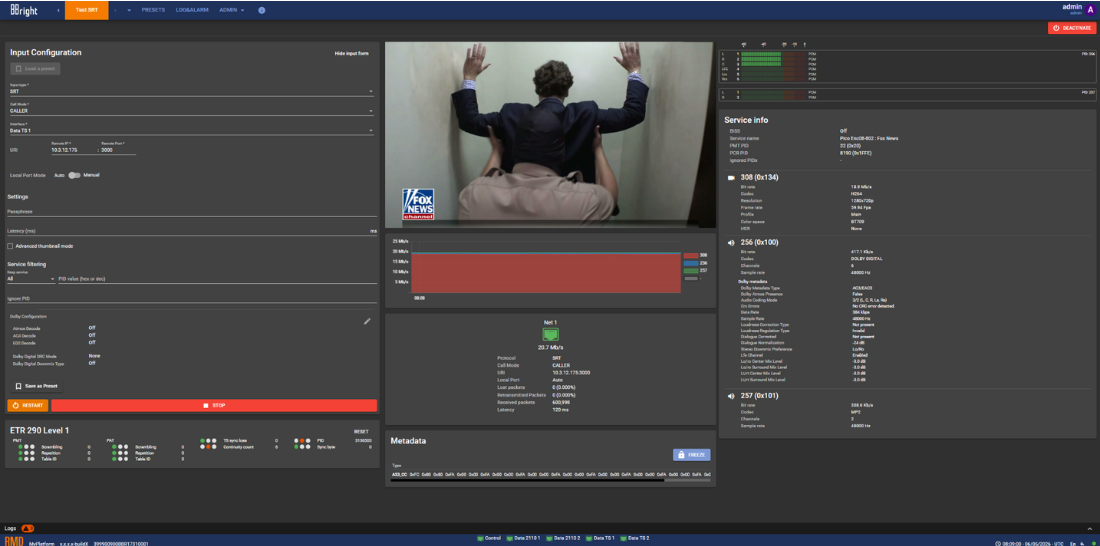
With the BBright RMD, teams can go beyond basic connectivity checks and verify the actual content and structure of the live signal. Operators can confirm that the expected video is present, that audio services are available, that the service structure is correct, and that metadata is being carried as expected. Depending on the workflow, this may include checking transport stream integrity, bitrate behavior, service and PID presence, audio configuration, HDR metadata, or Dolby-related metadata.
This distinction is critical. A stream can be reachable from a network perspective and still be unusable for broadcast operations.
This is especially important in advanced contribution workflows involving UHD, HDR, multiple audio services, Dolby workflows, SCTE signaling or metadata-driven processing.
The real operational question is not: “Can we connect to the SRT stream?”
It is: “Can we confirm that this is the right live signal, with the right technical structure, from an independent location?”
That is the value of the RMD.
Why cloud deployment matters
Deploying the BBright RMD in AWS or in a private cloud makes the workflow particularly effective because it places the monitoring point outside both the sender and receiver environments.
From this neutral position, the RMD provides a third viewpoint in the transmission chain. It does not replace encoder-side monitoring or receiver-side monitoring. It adds the independent reference point that is often missing during incident resolution.
For contribution workflows involving multiple partners, venues, regions or service providers, this external viewpoint can become the operational reference. If the RMD receives the stream, the sender can demonstrate that the feed is externally available. If it does not, the sender knows where to focus first.
A typical live scenario
Imagine a content provider delivering a live event over SRT to a broadcast partner.
The event is about to start. The provider confirms that the encoder is running. The SRT output has been configured. The broadcast partner reports that they cannot receive the signal.
Without a neutral monitoring point, both sides start checking their own systems. The sender reviews the encoder, firewall and public address. The receiver reviews its decoder, SRT mode, port, passphrase and local network rules.
Precious minutes are lost.
Now deploy the BBright RMD in AWS with the same SRT connection parameters.
Within a short time, the operations team can determine whether the stream is visible from an independent external location.
If the RMD does not receive the feed, the sender knows that the SRT stream is not properly exposed. The investigation focuses on the contribution side: encoder output, SRT mode, public IP address, port, firewall, NAT or route.
If the RMD receives the feed, the situation becomes much clearer. The sender is delivering a reachable stream. The RMD can then validate the signal itself: video, audio, metadata and transport behavior.
If the content is valid and the final receiver still cannot access it, the receiving partner can focus on its own access path, firewall, NAT, SRT configuration or decoder setup.
The result is a faster, cleaner and more factual troubleshooting process. Instead of spending critical minutes debating responsibility, teams can immediately decide which side of the workflow needs attention.
From troubleshooting to operational confidence
The BBright RMD is designed for professional monitoring environments where remote visibility, signal validation and fast diagnostics are critical.
In SRT workflows, it brings value before, during and after the live event.
Before going on air, it can validate that the contribution feed is reachable from a neutral location.
During the event, it provides remote visibility into the live signal.
After the event, it helps engineering teams understand what happened if a transmission issue occurred.
This is becoming increasingly important as live workflows become more distributed. A single contribution chain may involve content providers, production teams, cloud platforms, telecom operators, service providers and broadcasters.
In that context, a neutral monitoring point is not a luxury.
It is an operational necessity.
Stop guessing. Start troubleshooting with facts.
SRT is a powerful protocol for live contribution, but it requires the right operational tools.
When a receiver cannot access a stream, teams need a fast and reliable way to determine whether the issue is on the sender side, the receiver side, or somewhere in the network path.
By deploying the BBright RMD in AWS or in a private cloud, operators gain an independent view of the live SRT feed:
- They can confirm that the stream is reachable.
- They can verify the content inside the signal.
- They can monitor transport behavior.
- They can decide where the investigation should continue.
The BBright RMD becomes the neutral point of truth for live SRT troubleshooting.
It helps broadcasters and service providers move away from assumptions, reduce time-to-resolution, and make faster operational decisions when every minute matters.
In live contribution, this is what ultimately protects the most important objective: