
A shared service architecture for broadcast and streaming convergence
Executive perspective
Broadcast and streaming are converging around live media. Traditional broadcasters increasingly distribute their linear services through streaming platforms alongside conventional broadcast networks. At the same time, streaming platforms are investing in professional production, playout and distribution infrastructure as they expand into premium live events.
They come from different worlds, but increasingly face the same operational challenge: how to create more audience experiences from the same live programme without multiplying complete production and playout chains.
A single live programme may need UHD and HD, HDR and SDR, multiple languages and audio experiences, accessibility services, regional identities, subtitles and different graphics or sponsorship treatments. When every variation becomes another complete channel chain, the organisation duplicates configuration, quality checks, monitoring and recovery. Each new experience becomes harder to launch and manage reliably.
This changes the architectural question. Instead of asking “How do we build another channel?”, organisations can start by asking “What is common to the service, and where does each audience variation really need to occur?”
BBright proposes a shared ST 2110 service foundation built around one authoritative programme, keeping picture, audio, timed text and metadata synchronised until each broadcast, operator or streaming destination applies the processing and adaptation it requires.
Rights, regulation, latency and resilience can still require dedicated paths. The design task is to preserve what can be shared, introduce variation where it adds value, and verify the audience experience end to end.
1. Why output growth increases operating effort
A live programme may need UHD and HD pictures, HDR and SDR versions, several languages, accessibility services and regional sponsorship. Building a complete chain for each requirement can duplicate much of the same content and processing.
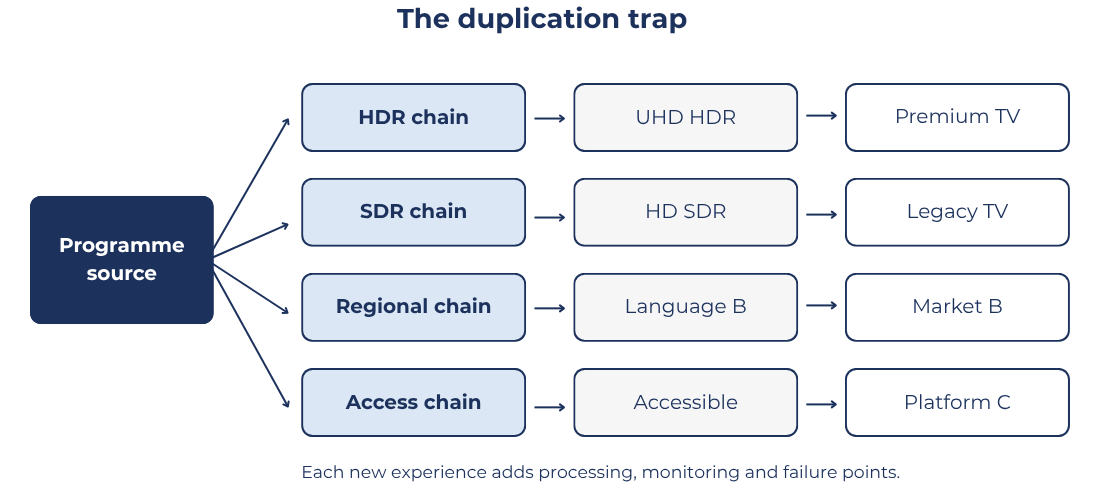
Figure 1 A separate chain for each requirement reproduces processing and operational work.
The operational burden extends beyond equipment. Teams repeat setup, quality checks, monitoring and incident response. Subtitle and metadata interfaces multiply, while creative teams may rebuild graphics in regional systems. More conversions can also make the origin of an output fault harder to identify.
The first design task is therefore to distinguish a genuine need for isolation from a variation that can be assembled later. That distinction determines which parts of the workflow should remain common.
Access the full White Paper here.