White Paper – SRT vs RIST for professional video contribution and distribution

A practical, implementation-aware comparison for broadcast, live production, distribution, cloud and premium ProAV workflows.
Executive summary
Reliable transport over IP is no longer a niche engineering topic. Live sports, remote production, affiliate delivery, cloud ingest and premium event workflows increasingly depend on resilient media paths across imperfect networks. Two protocols are frequently considered for this role: Secure Reliable Transport (SRT) and Reliable Internet Stream Transport (RIST).
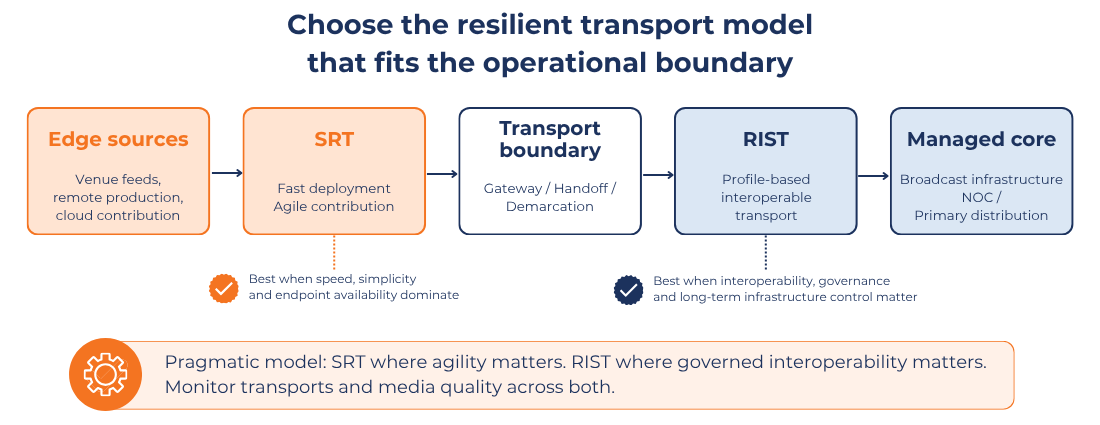
They solve a similar packet-loss problem, but they are optimized for different operational models. SRT is an integrated transport session with broad endpoint availability and a strong fit for fast deployment. RIST is a VSF-defined, profile-based toolkit that becomes especially attractive when interoperability, formal acceptance testing and long-term infrastructure governance matter.
The decision in one sentence
SRT is usually the simplest path to get a reliable live feed moving. RIST is often the stronger choice when profile-based interoperability, formal testing and long-term infrastructure governance matter.
Five conclusions:
- Both protocols rely on retransmission as a central recovery mechanism. Optional FEC capabilities also exist in specific SRT configurations and RIST Advanced Profile protection levels. Latency remains part of the engineering design, not an inconvenience to remove blindly.
- SRT is pragmatic when deployment speed, ecosystem familiarity and software or cloud endpoint availability dominate.
- RIST is compelling when the infrastructure must remain specifiable, testable and replaceable across vendors and equipment generations.
- Feature claims are not enough. Validate payloads, versions, profiles, security modes, recovery settings, redundancy behavior and exposed metrics end to end.
- Monitor the recovered and decoded media, not only whether the session is connected.
Want the full picture? Download the White Paper here:
Download