How protocol agility, resilient routing and operator-centric monitoring protect the media core in complex live IP workflows
Technical perspective
Imagine a broadcaster preparing a major live event. In one master control room, operators receive feeds from broadcast encoders, remote production teams, cloud platforms and external partners. Some arrive as SRT over the public Internet, others as RIST or MPEG-TS over managed IP links. Each source may bring different latency, reconnection behaviour, service structure, PID mapping, audio layout or bitrate profile.
The media core cannot be redesigned every time a partner reconnects with different parameters. Master control, monitoring, routing and downstream delivery need a stable operational boundary, even when the contribution edge remains variable.
This is the role of a modern IP Gateway: accept variability at the workflow boundary, keep transport behaviour predictable, expose the service clearly to operators and protect the operational core from unnecessary change.
The central idea
The BBright IP Gateway protects the media core by absorbing change at the edge and presenting a consistent transport, monitoring and control layer.
The sources, networks and protocols may change; the operational model should remain stable.
The gateway problem has changed
Traditional gateways were often evaluated through a simple checklist: supported inputs, supported outputs and maximum throughput. Those criteria still matter, but they no longer describe the operational challenge.
Live IP environments now receive services from dedicated appliances, software encoders, cloud platforms, remote teams and external partners. Feeds may use SRT, RIST or MPEG-TS over IP and travel over managed links or temporary Internet paths. Even when the content is correct, bitrate, latency, reconnection behaviour, service structure and metadata can vary from one source to another.
The production core, however, still needs predictable service behaviour. The IP Gateway therefore becomes the place where variability is accepted, understood and translated into a stable operational model.
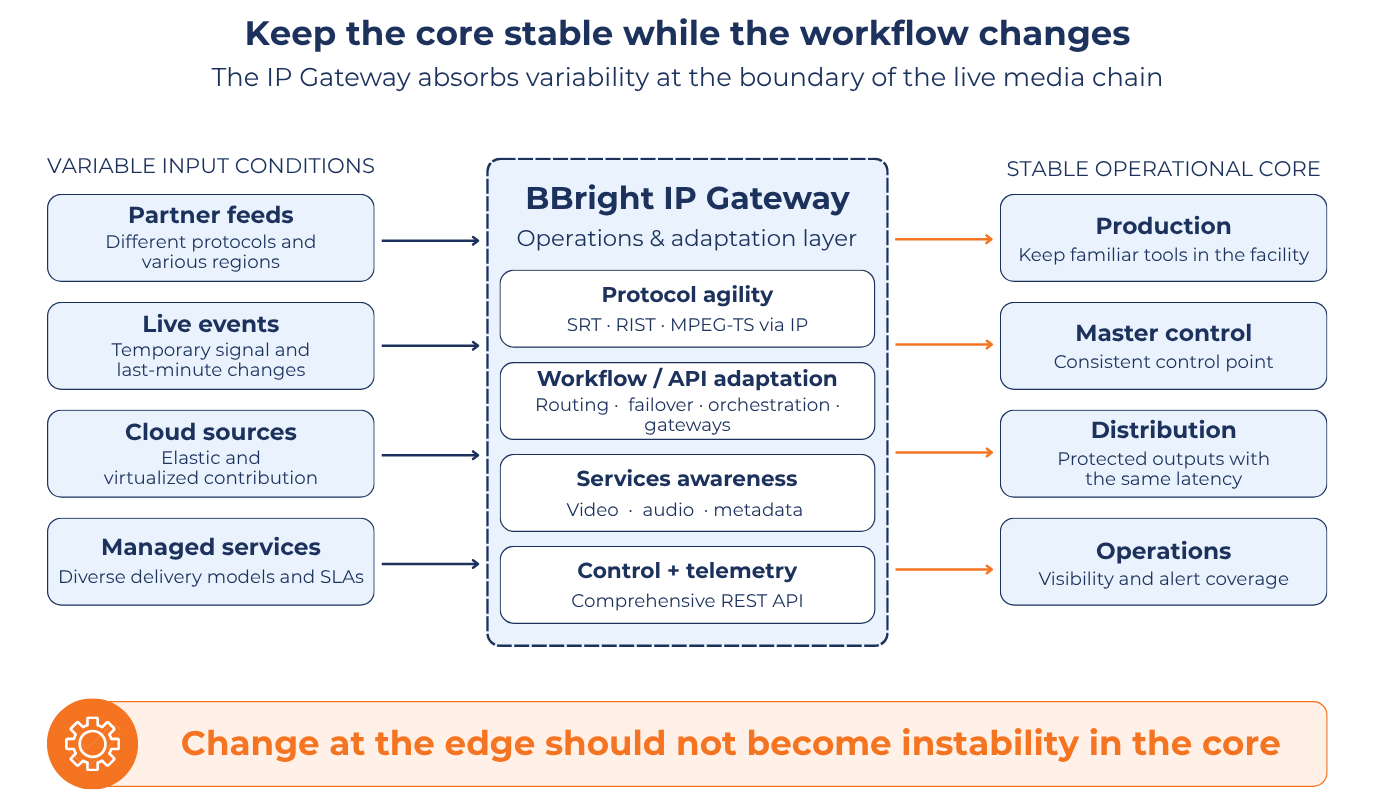
Figure 1 – The IP Gateway protects stable operations by absorbing change at the workflow boundary.
Core stability before feature count
Core stability is not only a hardware reliability metric. It is the ability of the workflow to remain understandable and controllable when conditions change. A stable gateway should reconnect deterministically, apply consistent routing policies, maintain service visibility and expose degradation before it becomes a production incident.
This matters in high-value live operations. An unstable source should not force operators to redesign the production chain. A temporary contribution path should not require a new monitoring method. A protocol change should not create a new operational model.
For BBright, the IP Gateway is designed to keep transport, routing and monitoring simple and robust. The objective is not to multiply features for their own sake, but to make live workflows more predictable.
Adapt to the workflow, not the other way around
There is no universal contribution protocol for every project. SRT is widely implemented and practical for rapidly connecting external partners or software-based workflows. RIST offers a standards-based, profile-driven approach that can suit multi-vendor and infrastructure-grade services. MPEG-TS over IP remains central to many managed contribution and distribution environments.
The important choice is operational: select the protocol, latency, recovery behaviour and network model that fit the service, then expose that service through the same gateway and control framework.
BBright IP Gateway brings SRT, RIST and MPEG-TS over IP into one software layer. Services can be configured, supervised and exposed to external systems through the same comprehensive REST API, so the transport choice remains a service-level decision rather than an architectural constraint.
Monitoring should answer operator questions
During a live event, operators do not need more data first. They need to know whether the service is usable, whether it is degrading and where the issue is most likely located. A green connection indicator confirms that a session exists; it does not confirm that the expected programme, audio, service structure or transport quality is usable.
BBright IP Gateway monitoring is designed to follow the way incidents are investigated: service confidence first, then payload validation, transport health and root-cause orientation.
- Service confidence
Can the operator see the expected programme? – Live thumbnails, audio meters, input and output status.
- Payload validation
Is the stream structure stable? – Service information, PID information, total and per-PID bitrate views, ETR 290 for MPEG-TS.
- Transport health
Is the network path degrading? – SRT and RIST statistics, reconnection state, packet loss and recovery indicators, latency and bitrate trends.
- Root-cause orientation
Where should the operator act? – Correlation between service, payload and transport indicators, with REST API telemetry for central logging or specialist probes.
The objective is not to replace every specialist probe. It is to place actionable information where the service is received, adapted and delivered. When deeper packet-level investigation is required, the REST API can feed centralised logging or analysis tools without making those tools the primary operational interface.
One software layer, several deployment models
The gateway’s operational role should remain consistent on-premises, in a virtualised data centre or in the cloud. BBright IP Gateway is available as an appliance, virtual machine or AWS instance, allowing deployment to follow the workflow without changing the product model.
Capacity can also scale with the site. Smaller edge deployments can start with a limited number of inputs, while high-density configurations can support up to 120 feeds and up to 10 Gbps per instance, depending on configuration, instance type and stream profile.
Open control without binding the workflow
The gateway is rarely the top-level control system. Broadcasters and service providers may use in-house automation, a commercial orchestration platform or a combination of tools. The media layer should therefore expose its capabilities clearly without assuming which platform sits above it.
BBright IP Gateway provides a comprehensive REST API for configuration, control, status and telemetry. Engineering teams can create service templates, automate provisioning, collect operational data and integrate the gateway into their preferred supervision environment.
When transport is not enough
Some services require more than transport adaptation. A feed may be technically valid but still arrive with an audio layout, codec, frame rate, resolution or service mapping that is incompatible with the downstream workflow.
In those cases, the gateway should remain the common transport, routing, monitoring and API foundation, while the required media processing is added only where it creates value. BBright Decoder or Encoder blocks can complement the workflow when audio processing, service remapping, codec handling or format normalisation is required. Straightforward services remain simple; complex services gain the processing they need without turning the gateway into a monolithic processor.
The gateway should become invisible, until conditions change
The best gateway is not the one that generates the most dashboards during normal operation. It is the one that keeps the service predictable, reveals meaningful degradation early and helps the operator understand what changed when a workflow stops behaving as expected.
That is the role BBright IP Gateway is designed to fulfil: SRT, RIST and MPEG-TS over IP interworking, resilient routing, integrated service monitoring, flexible deployment and comprehensive REST API control in one platform. The protocols, sources and network conditions may change; the operational core does not have to.
BBright IP Gateway at a glance
Capability |
BBright approach |
| Transport | SRT, RIST and MPEG-TS over IP |
| Gateway functions | Protocol handling, routing, reconnection policies and multi-destination delivery |
| Monitoring | Video thumbnails, audio meters, service/PID information, bitrate views, ETR 290 for MPEG-TS and SRT/RIST statistics |
| Deployment | Appliance, virtual machine or AWS instance |
| Scale | From small edge deployments to high-density configurations, depending on instance type, workflow and stream profile |
| Control | Comprehensive REST API for configuration, control, status and telemetry |
| Optional media processing | BBright Decoder or Encoder blocks can be added where audio processing, service remapping, codec handling or format normalisation is required |
Further reading
Choosing the right resilient transport protocol remains an important part of designing reliable contribution and distribution workflows. For a detailed technical comparison of SRT and RIST, including their respective architectures, operational models and most relevant use cases, read the BBright white paper: SRT vs RIST for Professional Video Contribution and Distribution.