Interoperability and core stability: Why BBright Encoder, Gateway and Decoder simplify broadcast operations
Blog & white papers
18 March 2026
For host broadcasters, regional sports networks and service providers, operating large-scale contribution and distribution infrastructures requires balancing two fundamental priorities: interoperability and stability. Whether signals are routed through nodal facilities, master control rooms, or network operations centers, the reality of modern broadcast workflows is one of technological diversity. Contribution feeds can originate from cloud platforms, open-source tools, or dedicated hardware encoders, and they must all integrate seamlessly into production infrastructures that often combine SDI and 2110 environments.
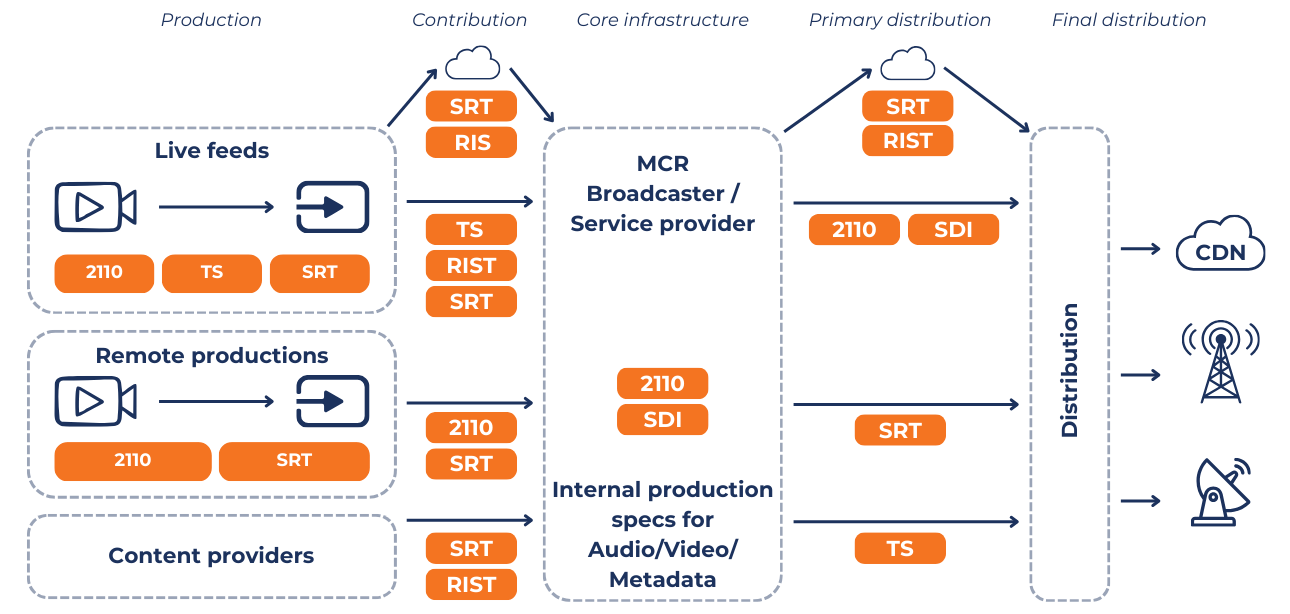
The challenges of video transport, from camera to end user
In such contexts, the challenge is not simply to encode or decode video streams. The real objective is to ensure that signals from very different origins can be received, adapted, monitored and delivered with complete reliability. This is precisely the role of the BBright Encoder, Gateway and Decoder suite. Designed for real-world broadcast operations, it provides the flexibility and interoperability required to integrate heterogeneous contribution sources while maintaining the operational stability expected from professional broadcast infrastructures.
A key element of this approach lies in the exceptional interoperability of the BBright decoder platform. In contribution environments, operators frequently need to handle feeds generated by a wide range of technologies. Some sources may originate from cloud-based encoders or open-source software pipelines, including streams produced with FFmpeg operating in variable bitrate modes (VBR). Others may come from dedicated broadcast hardware producing very high bitrate, low-latency contribution feeds, often encoded in HEVC using professional profiles such as 4:2:2 10-bit.
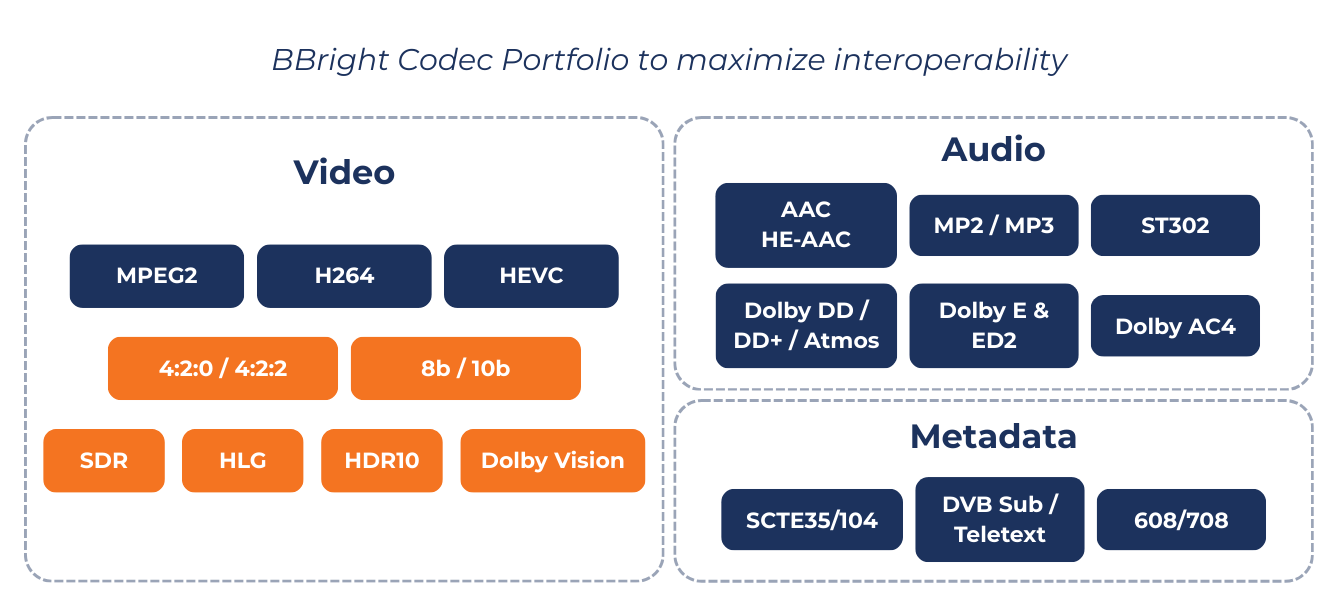
Rather than forcing operators to standardize every incoming feed through additional transcoding or adaptation layers, BBright decoders are designed to receive and decode these diverse streams directly. This capability allows facilities to integrate both cloud and on-premise contribution sources within the same infrastructure, while maintaining high video quality. In practice, this greatly simplifies contribution workflows and removes many of the compatibility concerns that traditionally complicate large-scale broadcast operations.
Beyond codec compatibility, seamless integration into existing production environments is equally important. Broadcasters often rely on strict internal signal specifications, especially when integrating external feeds into established SDI or IP production infrastructures. Through precise handling of both SDI and SMPTE ST 2110 interfaces, BBright decoder solutions make it possible to conform incoming contribution feeds to the exact technical format required by the facility.
This capability significantly reduces operational friction within nodal facilities and master control rooms. Audio mappings can be preserved without the need for additional conversion stages, ensuring that channel layouts remain consistent throughout the production chain. Video processing functions embedded directly in the decoder allow operators to perform upscaling, downscaling or frame-rate conversion up to Ultra HD whenever required, guaranteeing that incoming signals match the internal production standards before entering the core broadcast infrastructure.
Audio compatibility is another critical component of interoperability, particularly for sports broadcasters and service providers delivering content to multiple platforms. BBright decoders provide certified support for the full range of Dolby broadcast formats, including Dolby Digital, Dolby Digital Plus, Dolby Digital Plus with Dolby Atmos, AC-4, Dolby E and ED2. This broad compatibility enables operators to handle both traditional broadcast audio workflows and next-generation immersive formats within the same decoding infrastructure.
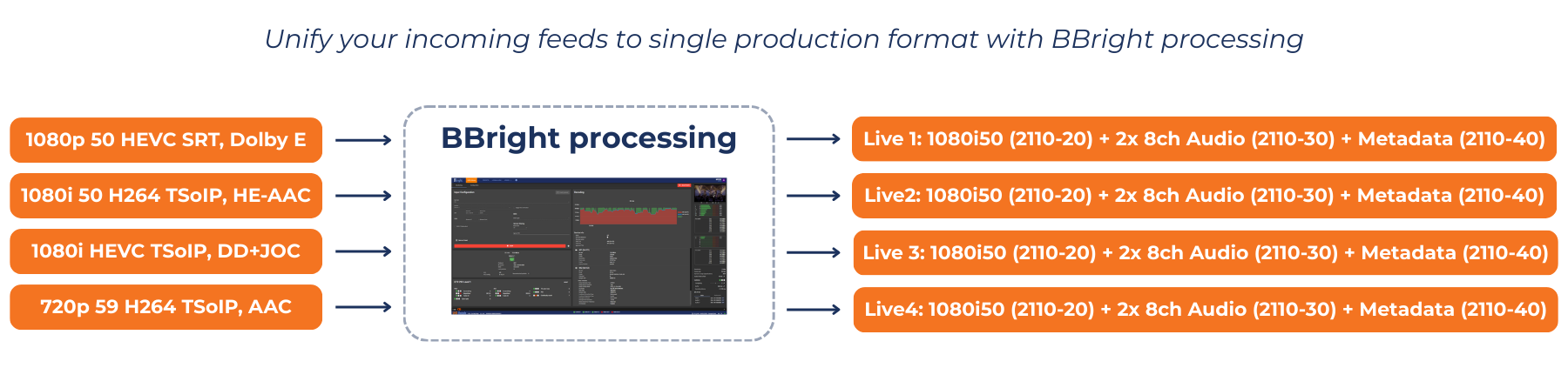
(example of BBright processing to unify incoming live feeds to a single production format)
While signal compatibility is essential, operational teams also need comprehensive visibility into system behavior. In large broadcast environments, NOC and MCR operators must be able to detect anomalies quickly and diagnose issues with precision. For this reason, the BBright platform includes a user interface specifically designed to support operational monitoring. The interface provides detailed alarm reporting alongside multiple real-time indicators of stream health and system performance.
Operators can immediately verify signal presence through integrated video thumbnails and audio bar meters, while bitrate graphs allow engineers to observe the behavior of incoming streams over time. Transport-level monitoring includes ETR 290 checks, and detailed statistics are available for contribution protocols such as SRT and RIST. By presenting this information in a clear and accessible interface, the platform enables operators to maintain full situational awareness across complex multi-feed environments.
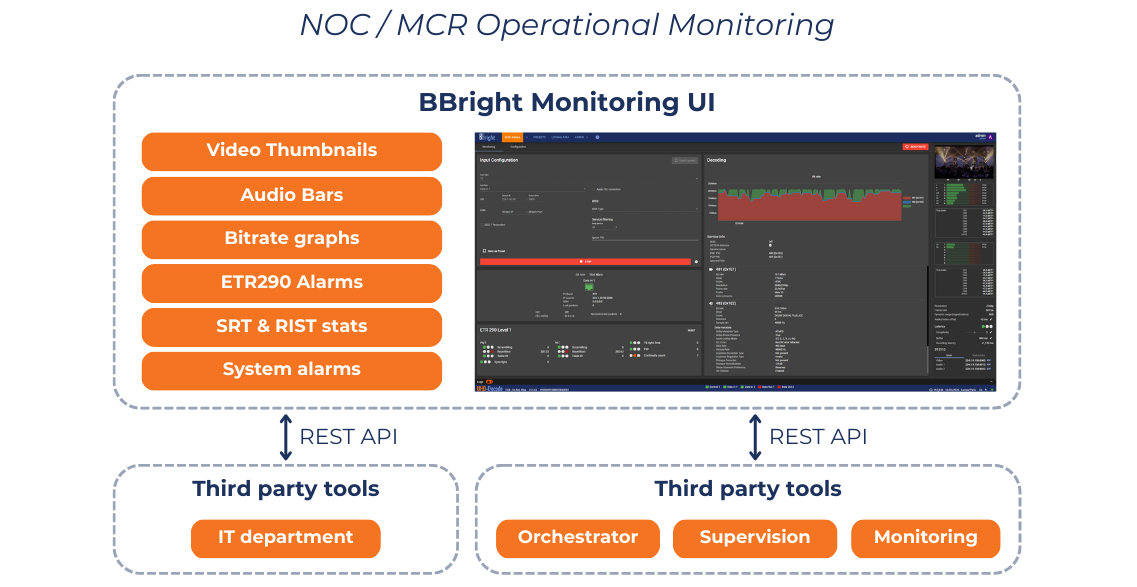
In parallel with this operational visibility, the platform also supports deep integration into automated broadcast infrastructures. All BBright components are fully accessible through a REST API, allowing configuration, monitoring and control to be integrated into larger orchestration systems or facility-wide monitoring frameworks. This open architecture enables broadcasters and service providers to embed the encoder, gateway and decoder functions into their existing operational workflows without introducing isolated systems that require separate management. Proof of this can be seen, for example, in the partnerships and integrations of BBright solutions within the Skyline DataMiner and EVS Cerebrum environments.
For host broadcasters managing large-scale live events, regional sports networks distributing numerous live feeds, or service providers delivering contribution services to multiple clients, operational simplicity and reliability are essential. The BBright Encoder, Gateway and Decoder suite addresses these needs by combining deep interoperability, flexible signal adaptation, comprehensive monitoring and open integration capabilities. Recent announcements, including Host Broadcast Services deploying BBright encoders and decoders and Canal+ expanding its decoding infrastructure with BBright, illustrate how broadcasters are increasingly prioritizing interoperable and stable core infrastructures.
In a broadcast landscape where infrastructures continue to evolve across SDI, 2110 and cloud-based workflows, maintaining stability at the core of operations remains the central challenge. By focusing on interoperability and operational robustness, BBright provides a platform that allows broadcasters and service providers to integrate diverse contribution sources while preserving the reliability that mission-critical broadcast environments demand.