TTML & SMPTE ST 2110-43: One single stream for the whole world
Blog & white papers
12 March 2026
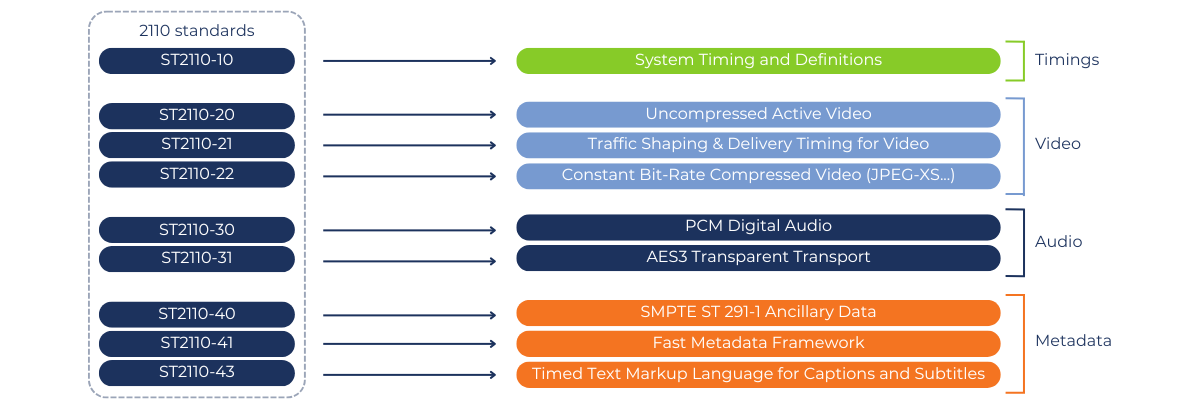
The transition to IP has fundamentally reshaped professional media infrastructures. Video, audio, and increasingly metadata now circulate as independent, precisely synchronized essences within the SMPTE ST 2110 framework. Yet for a long time, subtitles remained anchored in legacy paradigms: regional, constrained, and technologically fragmented.
With the emergence of SMPTE ST 2110-43 transporting Timed Text Markup Language (TTML), subtitles finally enter the IP era with the same level of coherence and universality as video and audio. The promise is simple and transformative: one single stream for the whole world.
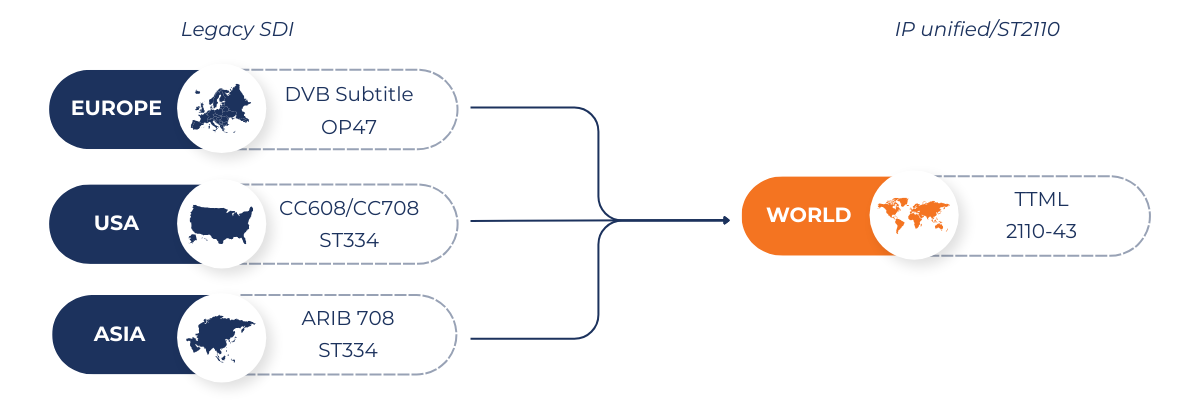
For decades, subtitle infrastructures have been shaped by geography rather than technology. In SDI environments, Europe, North America, and Asia each evolved their own systems. Character grids, rendering models, encoding schemes and transport mechanisms differed from one region to another. A broadcaster distributing internationally had to maintain parallel workflows, perform conversions at borders, and manage protocol-specific integrations for live production. What made sense in a standard-definition, regionally segmented world has become a structural inefficiency in today’s global, UHD-driven ecosystem.
TTML changes the paradigm at its foundation. Designed as a resolution-independent, XML-based subtitle model, it does not inherit the structural constraints of fixed teletext grids. For decades, the maximum number of characters per line, directly inherited from standard-definition broadcasting, forced editorial teams into constant compromises. Sentences had to be shortened, phrasing adjusted on the fly, meaningful nuances removed, or additional line breaks introduced purely to satisfy a technical ceiling that no longer made sense in HD, and certainly not in UHD. In practice, this limitation was genuinely burdensome. It complicated subtitle preparation, reduced linguistic fidelity, and often forced a trade-off between readability and accuracy.
With TTML, these constraints disappear. Typography, line length, and positioning become presentation parameters adapted to screen size and context, rather than rigid limits imposed by a legacy character matrix. Subtitles can finally be authored for modern HD and UHD environments with the same qualitative expectations applied to video and audio.
The introduction of ST 2110-43 is equally decisive. Within the broader architecture defined by the Society of Motion Picture and Television Engineers, timed text now becomes a native IP essence. Subtitles are no longer transported through side protocols or proprietary live interfaces such as Newfor or Control-A, which were designed exclusively for SDI-based live workflows. Instead, they travel alongside video and audio as synchronized, routable IP streams. This alignment eliminates the artificial divide between file-based and live subtitle processing. The same TTML format can flow from content preparation to playout, from live production to OTT packaging, without repeated format translations.
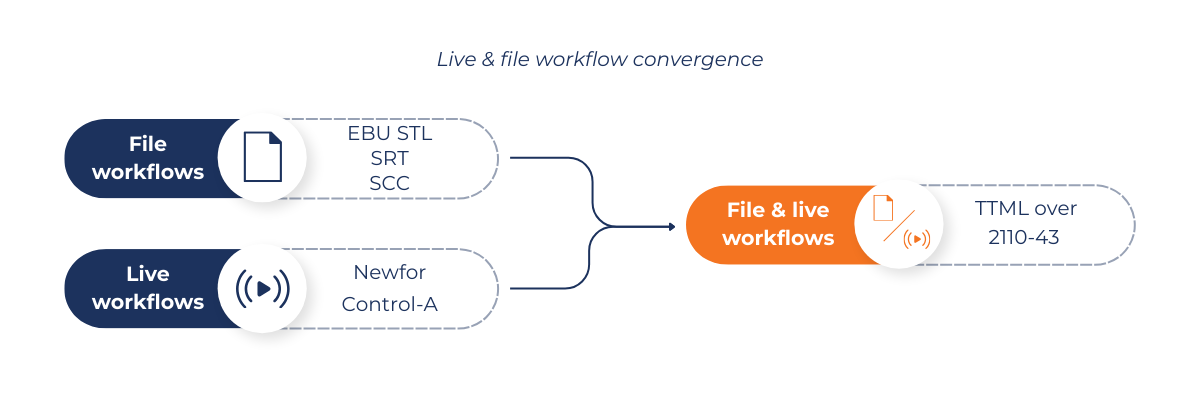
Operationally, this unification has profound consequences. Each format conversion stage that disappears removes potential latency, error vectors, and integration overhead. Engineering teams no longer need to maintain parallel subtitle ecosystems depending on whether content originates from a file-based workflow or a live event. The infrastructure becomes cleaner, more deterministic, and easier to scale.
Most importantly, TTML over ST 2110-43 enables true global standardization. Because TTML is not tied to a specific regional broadcasting heritage, it can serve European, American, and Asian distribution requirements simultaneously. A single master subtitle format can feed linear playout, contribution networks, and OTT platforms worldwide. The notion of region-specific subtitle streams becomes obsolete. What remains is a unified IP-based subtitle essence, ready for worldwide delivery.
This vision aligns perfectly with the realities of modern OTT distribution. Platforms today must support numerous languages, accessibility variants, and regional adaptations, whether in HD or UHD HDR ecosystems. Carrying multiple TTML tracks within a single ST 2110-43 environment provides the scalability such platforms require. It becomes possible to manage dozens of language versions without multiplying infrastructures.
BBright’s playout solutions already natively support up to 32 TTML subtitle tracks over ST 2110-43, across both live and file-based workflows. This capability is not an add-on; it is embedded within an IP-native architecture designed for global distribution. For OTT operators and tier-one broadcasters seeking to serve worldwide audiences with maximum operational efficiency, the approach is straightforward: one playout system, one IP subtitle standard, one globally compatible stream.
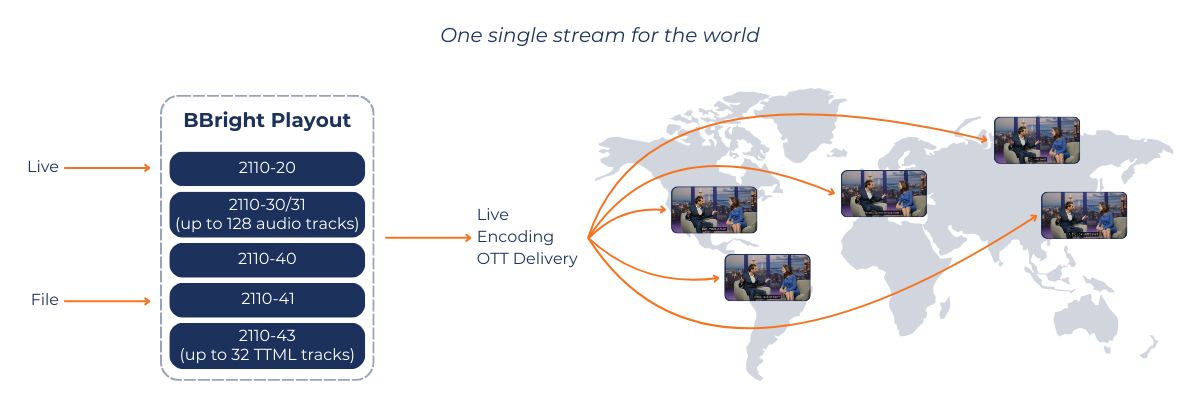
Subtitles were among the last components of the broadcast chain to fully embrace IP standardization. With TTML and ST 2110-43, they now join video and audio in a coherent, future-proof framework. Regional fragmentation gives way to global interoperability. Legacy constraints give way to UHD-ready flexibility. File and live workflows converge into a single architecture.
The result is more than technical modernization. It is a structural simplification of worldwide distribution.
One single stream. For the whole world.